

Ayurveda
Senanayake and the village wedegedera
Our village Getafix: Senanayake and the roots of Ayurveda at Ulpotha.
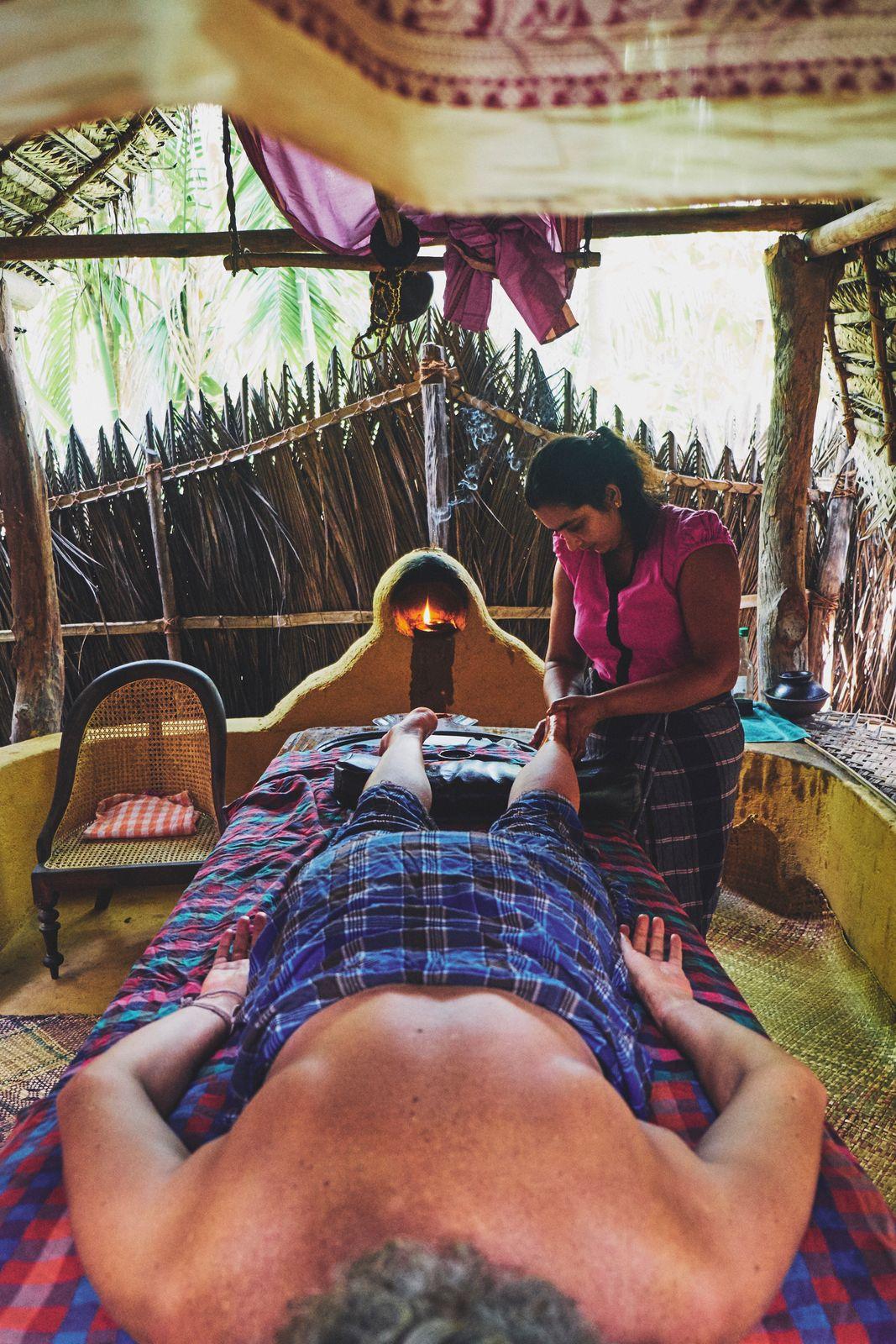
From a wide choice, Giles and Viren settled on their old neighbour, Senanayake, as Veda Mahaththaya, the village medicine man. He was wiry and stooped, with a mischievous glint in his eye, and he looked so much the part that he was soon known as Ulpotha's own Getafix.
Choosing a village medicine man over a qualified Ayurvedic doctor was deliberate. Medicinal knowledge in this part of the world has been handed down for more than 5,000 years, but it was only written down in the first century BC and shaped into something close to today's Ayurveda, the "knowledge of life", around 500 AD. At its heart is the idea of locality, that everything needed for a long and healthy life grows close to where you live. A Himalayan plant may do little for someone living in Sri Lanka's dry zone. Giles felt that standardising remedies from the top of India to the bottom of Sri Lanka sat awkwardly with that principle, and that plenty of small, local cures would be lost in the process. So Ulpotha began growing whatever medicinal plants Senanayake asked for, along with those requested by any villager who had an opinion on the matter, and most of them did.
Giles speaks from personal experience here. He arrived at Ulpotha with a stomach ulcer, a souvenir of years spent developing property in London, and a prescription for Losec and a course of antibiotics in his bag. Before taking any of it, he compared notes with Dayawathi, Nirosha's mother and Ulpotha's cook at the time, who seemed to have the same complaint. Every morning she brewed a dozen herbs into what he still calls the foulest drink he has ever tasted, and the two of them drank it together. Six months later, back in London, his doctor could find no trace of the ulcer and struggled to believe the pills had never been opened.
Then there was Cindy, who came from New Zealand with her partner Steve to host a season at Ulpotha, hoping months of village treatment might settle her severe eczema. When Giles arrived at Christmas it had spread from her arms over most of her body, and he begged her to go to Colombo for conventional care, not least because the woman greeting guests at a health retreat looked, in his words, like the walking dead. She refused. "I feel it is working," she told him through cracked lips, convinced the toxins were finally on their way out. Over the following weeks her skin settled, and when he saw her in Colombo on her last day in March it was clear. They stayed in touch for years and it never came back. Giles is the first to say these are one man's memories rather than medical evidence, and that this kind of rebalancing takes months, a world away from the quick relief of a hydrocortisone cream.
As word spread and more guests booked treatments, Senanayake, by then in his late sixties, struggled to keep up. He was never a doctor, simply a man with a remarkable store of plant knowledge, much like his neighbours. The moment of truth came when Giles walked into the wedegedera to find him probing a guest's ear with a rusty coat hanger. It was time, he decided, to find someone with a little more training, and how that happened, on the stairs of an old Colombo swimming club, is the next story.
More from the journal
Ayurveda
Ayurveda at Ulpotha
How Ayurveda works at Ulpotha alongside your yoga retreat, and which treatments are offered.
Ayurveda
A Beginner’s Guide to Ayurveda: What It Is and Why It Works
Ayurveda is a medical system from the Indian subcontinent with a documented history of around 5,000 years. The name comes from Sanskrit...
Keep exploring
Plan your stay
See this season's retreats, meet the teachers and therapists, or choose your dates.